How to Measure Sales Readiness Before Competitive Deals
Stop hoping your reps are ready. Here's a framework for measuring competitive sales readiness with real data — before the deal, not after the post-mortem.
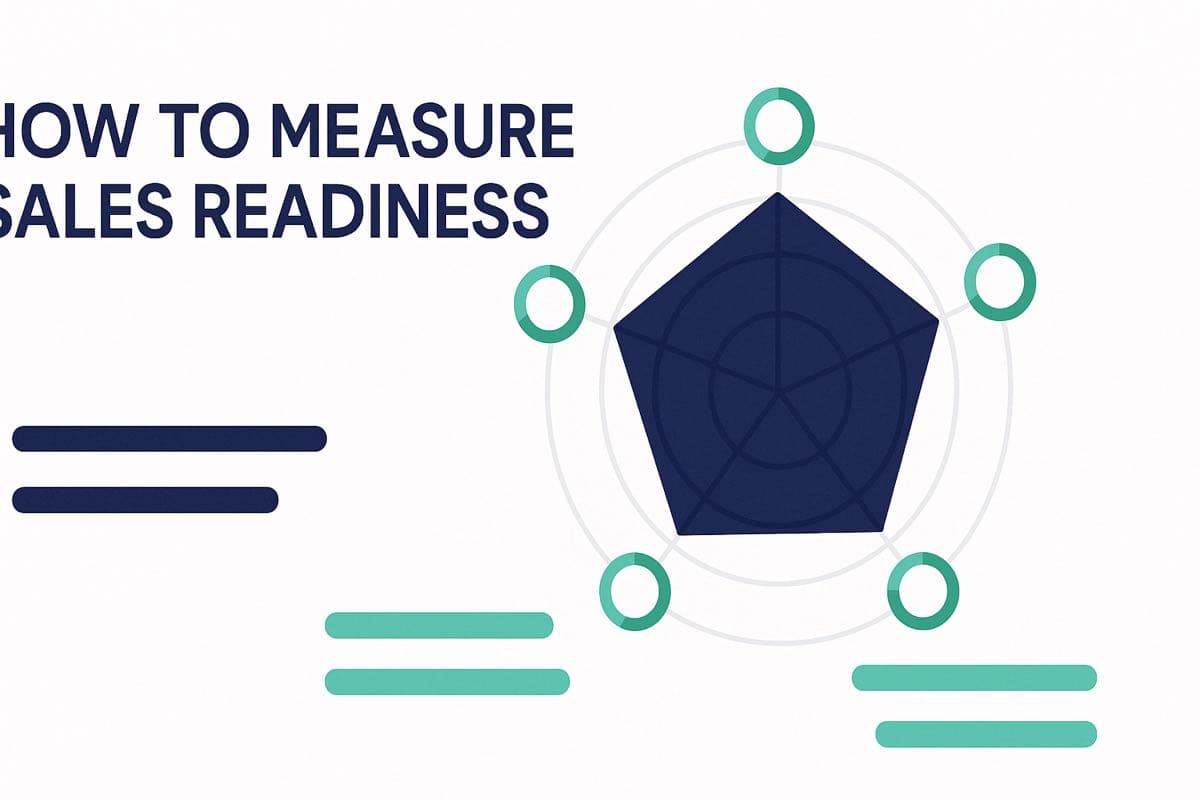
Most sales orgs can't answer a simple question: 'Is this rep ready for a competitive deal against Competitor X?' They track pipeline, quota attainment, and activity metrics — but not readiness. Here's a three-tier framework for measuring competitive preparedness with data, not gut feel.
Your best AE has a finalist meeting against your biggest competitor next week. Your VP of Sales asks: "Is she ready?"
The honest answer at most orgs is: "I think so?" Or: "She's our best rep, she'll figure it out." Or the most common: "She read the battlecard."
None of these are measurements. They're hopes. And hope is an expensive strategy when the deal is worth six figures.
Why readiness isn't measured today
Sales orgs are data-rich. Pipeline velocity, quota attainment, activity metrics, win rates, average deal size — these are tracked religiously. But ask "is Rep A ready for a competitive deal against Competitor X?" and you get silence.
The reason is simple: there hasn't been a good way to measure it. Competitive readiness is a skill — it lives in a rep's ability to respond under pressure. Until recently, the only way to assess it was to watch them on a live call (too late) or sit in on a roleplay (doesn't scale).
That's changing. AI-powered practice tools now generate quantitative readiness scores. But even without tools, you can build a measurement framework.
The three-tier readiness framework
Tier 1: Knowledge (can they find it?)
This is the baseline. Does the rep know the battlecard exists? Have they accessed it recently? Can they name the competitor's top 3 positioning points?
How to measure: Battlecard access logs from your CI platform (Klue, Crayon, Highspot). Quiz or certification on key competitive facts. Self-reported confidence survey before competitive deals.
What it tells you: Whether the rep has been exposed to the intelligence. It doesn't tell you whether they can use it.
Benchmark: Aim for 80%+ of reps accessing battlecards for their top 3 competitors within the last 30 days. Most teams are under 40%.
Tier 2: Skill (can they deliver it?)
This is the critical middle layer that most programs miss entirely. Can the rep articulate your competitive differentiation out loud, in response to realistic pressure, without reading from a document?
How to measure: Practice drill scores — either from AI roleplay tools or structured manager/peer roleplay with a scoring rubric. Key dimensions to score: Did the rep use the key differentiators? Did they handle the top 3 objections? Did they deploy at least one trap question? Did they avoid common pitfalls (badmouthing the competitor, getting defensive, making unsupported claims)?
What it tells you: Whether the rep has converted knowledge into executable skill. This is the strongest predictor of competitive call performance.
Benchmark: Reps should score 70%+ on drill assessments against their active pipeline competitors. Reps who score below 50% are at high risk of losing competitive deals.
Tier 3: Outcome (did it work?)
This is the lagging indicator — competitive win rate, deal velocity in competitive scenarios, and average deal size in competitive vs. non-competitive deals.
How to measure: CRM data. Tag deals as competitive (with specific competitor) and track win rate, cycle length, and discount rate. Compare against non-competitive deals and against historical baselines.
What it tells you: Whether the entire system — intelligence, practice, and execution — is producing results. But it tells you 60-90 days after the fact.
Benchmark: Highly variable by industry and product. Track the trend, not the absolute number. A 5-10 percentage point improvement in competitive win rate over a quarter is significant.
Building a readiness dashboard
The most useful readiness view for a sales leader combines all three tiers in a single dashboard. Here's what it should show:
Rep-level view. For each rep, for each active competitor in their pipeline: knowledge score (have they accessed the battlecard?), skill score (have they practiced, and how did they score?), and a composite readiness rating.
Team-level view. Aggregate readiness by competitor. If you have 8 deals against Competitor X this quarter, what percentage of the assigned reps have practiced? What's the average skill score? This tells you where the team is strong and where it's exposed.
Trend view. Readiness scores over time — are reps improving with practice? Are there competitors where the team consistently scores low (indicating a battlecard gap or a genuinely tough competitive scenario)?
Pipeline risk view. Flag specific deals where the assigned rep has low readiness against the tagged competitor. These are the deals most likely to be lost due to competitive unpreparedness — and the ones where a targeted practice session could change the outcome.
What good looks like
Here's a concrete example of how this plays out.
A VP of Sales opens the readiness dashboard on Monday morning. She sees 12 competitive deals in the current quarter — 5 against Competitor A, 4 against Competitor B, 3 against Competitor C.
For Competitor A: 4 of 5 assigned reps have practiced in the last 2 weeks. Average skill score is 78%. One rep hasn't practiced at all — and her deal closes next week.
For Competitor B: Only 1 of 4 reps has practiced. Average score is unknown. This is a blind spot.
For Competitor C: All 3 reps have practiced, average score is 85%. This team is ready.
The VP now has data to act on. She asks the unprepared Competitor A rep to run a drill before the close. She flags Competitor B as a team-wide gap and schedules a practice block. She knows Competitor C deals are in good hands.
None of this was possible when "readiness" was a gut feeling.
Getting started without specialized tools
You don't need an AI platform to start measuring readiness. Here's a manual version you can implement this week.
Step 1: Pick your top competitor by deal frequency. Just one.
Step 2: Create a 5-question quiz. Cover the competitor's main positioning, your top 3 differentiators, and the most common objection. Send it to the team. This measures Tier 1.
Step 3: Run a 15-minute roleplay. Have a manager or peer play the competitor's positioning and score the rep on a simple rubric: used differentiators (yes/no), handled the top objection (1-5 scale), deployed a trap question (yes/no). This measures Tier 2.
Step 4: Track competitive deals. Tag competitive deals in your CRM with the specific competitor. Track win rate over the quarter. This measures Tier 3.
This is manual. It doesn't scale beyond your top 1-2 competitors. But it proves the concept and builds the organizational muscle for readiness measurement. Once you see the value, the case for tooling writes itself.
The readiness-to-revenue connection
The ultimate question: does measuring readiness actually improve win rates?
The evidence says yes. Teams that implement practice programs with readiness scoring see measurable improvements in competitive deal outcomes, typically within one quarter. The mechanism is straightforward: when reps know they'll be measured on competitive preparedness, they prepare. When they prepare, they perform better. When they perform better, they win more.
The reps who practice 3 or more times against a specific competitor before a deal perform significantly better than reps who only read the battlecard. That's not surprising — it's how skill development works in every domain. What's new is that we can now measure it at scale, predict which deals are at risk, and intervene before the outcome is decided.
Sales readiness is moving from gut feel to data. The teams that make this shift first will have a meaningful competitive advantage — not just better battlecards, but proof that their reps can use them.
Related Articles
Best AI Sales Roleplay Tools for Competitive Selling (2026)
A hands-on comparison of the top AI sales roleplay platforms — Hyperbound, Second Nature, WinOver, and more — rated on what matters for competitive deal prep.
Hyperbound vs. WinOver: Which AI Sales Roleplay Tool Is Right for You?
An honest comparison of Hyperbound and WinOver — two AI sales roleplay platforms built for different problems. Here's how to choose.
Why Your Reps Don't Use Battlecards (And How to Fix It)
You built great battlecards. Your reps aren't using them. Here's why — and the three changes that actually move battlecard utilization from <15% to 60%+.