Why Your Reps Don't Use Battlecards (And How to Fix It)
You built great battlecards. Your reps aren't using them. Here's why — and the three changes that actually move battlecard utilization from <15% to 60%+.
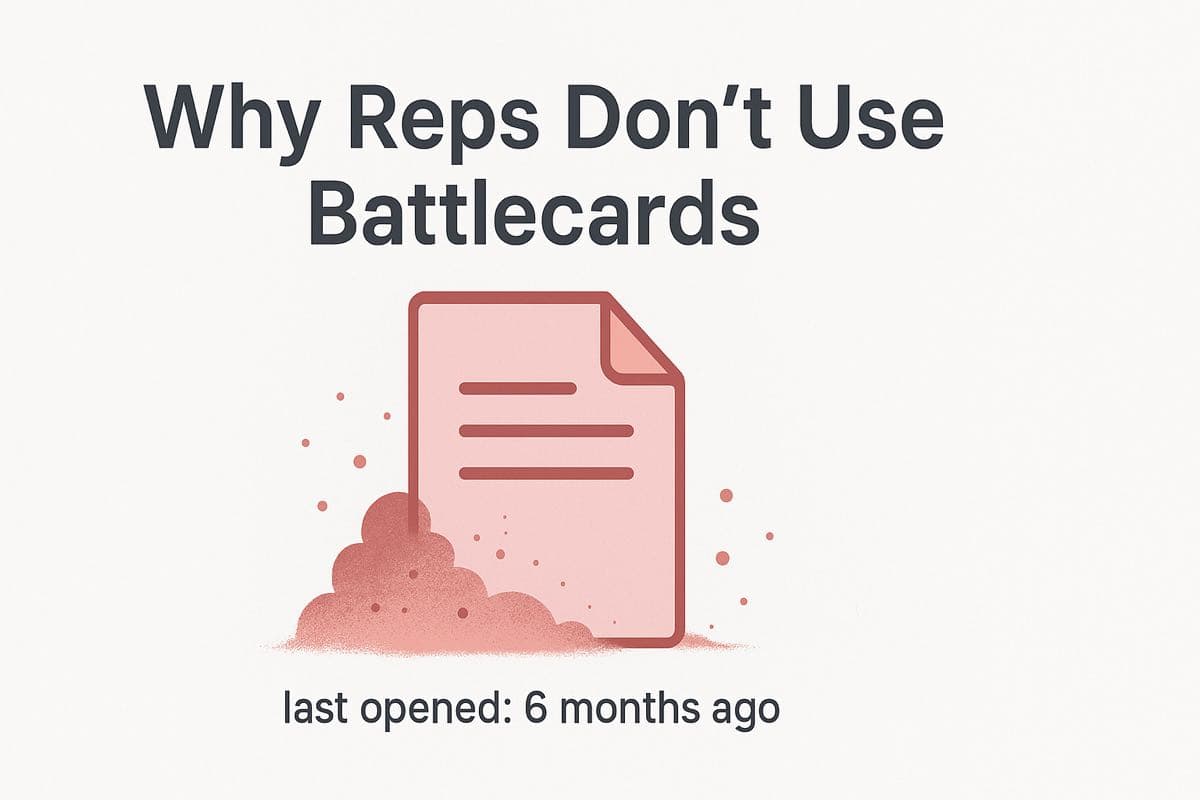
The average battlecard utilization rate on live calls is under 15%. Not because the intel is bad — because reading a document doesn't prepare reps to use it under pressure. The fix isn't better formatting. It's practice.
Here's a number that should haunt every CI and product marketing team: fewer than 15% of competitive sales calls involve a rep actually using their battlecard.
Not because the battlecards are bad. Most of the time, they're excellent — carefully researched positioning, sharp objection responses, well-crafted trap questions. The problem isn't the content. The problem is the delivery mechanism.
The three real reasons reps don't use battlecards
1. Reading doesn't build recall under pressure
A battlecard is a reference document. It works great when you have time to read it — during onboarding, in a team meeting, before a deal. It doesn't work when a prospect drops a competitor name 22 minutes into a discovery call and your rep has 3 seconds to respond.
The cognitive science here is clear: passive reading creates recognition memory, not recall memory. Your rep can recognize the right response when they see it on the page. They can't recall it when they need it on a call. These are fundamentally different memory systems.
This is the same reason athletes don't prepare for games by reading the playbook. They run drills.
2. The access problem is a red herring
A common response to low utilization is "we need to make battlecards easier to find." So teams embed them in Salesforce, push them through Slack, integrate with Gong and Highspot.
Better access helps. But it doesn't solve the core problem. Even reps who can pull up a battlecard in 5 seconds still don't do it mid-call. Because mid-call, they're listening, building rapport, managing the conversation flow. Pulling up a document breaks all of that.
The battlecards that get "used" via better distribution are typically read before the call (good) but not recalled during the call (the thing that actually matters).
3. There's no accountability loop
If nobody knows whether reps used the competitive positioning in their last deal — and most orgs don't track this — then there's no feedback mechanism. Reps who wing it and reps who prepare look the same until the deal is won or lost. And by then, it's too late for coaching.
CI teams track pageviews on their battlecards. But pageviews don't tell you if a rep can actually deliver the positioning under pressure.
What actually moves the needle
Change 1: Add a practice step between reading and doing
The single highest-impact change is turning battlecard consumption from passive (reading) to active (practicing).
This means some form of drill where the rep has to articulate the competitive positioning out loud, under time pressure, against realistic objections. The format matters less than the principle — it could be peer roleplay, manager coaching, or AI-powered drills. What matters is that reps have to use the content before they need it.
Teams that add a practice step see battlecard utilization on live calls jump from under 15% to 40-60%, because the positioning moves from recognition memory to recall memory.
Change 2: Make readiness visible
What gets measured gets managed. If you can show a VP of Sales a dashboard that says "4 of your 10 AEs have never practiced against Competitor X, and you have 3 competitive deals in pipeline against them this quarter" — the behavior change follows.
Readiness scoring turns competitive preparation from an honor system into a managed process. It also gives CI teams the ROI data they need to justify their programs.
Change 3: Reduce the friction to minutes
Manager roleplay works, but the math doesn't. Ten reps times 3 competitors times 30 minutes per session equals 15 hours per month per manager. That's a full-time job on top of their actual job.
The practice mechanism needs to be async, private, and take 15 minutes or less. Reps should be able to practice against Competitor X at 10pm the night before a big call without scheduling anything or performing in front of peers.
When practice is this easy, voluntary usage goes up 4-5x compared to scheduled roleplay sessions.
The CI team's opportunity
If you're a product marketing or competitive intelligence leader reading this, here's the reframe: low battlecard utilization isn't a rep problem. It's a delivery problem. Your content is good. The mechanism for turning it into rep behavior is what's missing.
The teams that solve this become the engine behind their org's competitive win rate — not just a content factory. And they can prove it with data: readiness scores, practice frequency, utilization rates on live calls, and ultimately, competitive deal outcomes.
Your battlecards are already written. The question is whether your reps can use them when it matters.
Related Articles

Battlecard vs. Battle Drill: What's the Difference and Why It Matters
Most teams stop at the battlecard. The teams that win competitive deals go one step further — they drill. Here's why the gap between knowing and doing is where deals die.
Best AI Sales Roleplay Tools for Competitive Selling (2026)
A hands-on comparison of the top AI sales roleplay platforms — Hyperbound, Second Nature, WinOver, and more — rated on what matters for competitive deal prep.
Hyperbound vs. WinOver: Which AI Sales Roleplay Tool Is Right for You?
An honest comparison of Hyperbound and WinOver — two AI sales roleplay platforms built for different problems. Here's how to choose.